Chapter 12 - Simple Harmonic Oscillator
Several examples that make use of the built-in Simple Harmonic Oscillator tools:
from numpy import sqrt,linspace,exp
from qutip import *
import matplotlib.pyplot as plt
%matplotlib inline
N = 40 # size of the Hilbert space.
# N needs to be large enough that matrix is not truncated
a = destroy(N)
n = a.dag()*aDefine a coherent state with
psi = coherent(N,1)psiLoading...
Expectation value :
psi.dag()*n*psi(1+0j)# Convert to a density matrix:
psi_dm = ket2dm(psi)psi*psi.dag()Loading...
# Fock state distribution of the coherent state:
plot_fock_distribution(psi_dm)
(<Figure size 640x480 with 1 Axes>,
<Axes: xlabel='Fock number', ylabel='Occupation probability'>)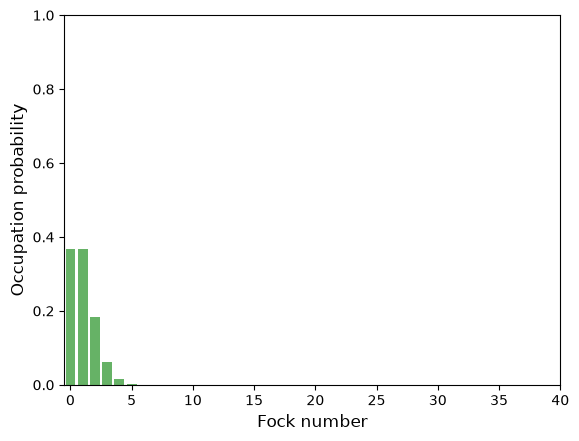
Also look at other coherent states:
# With larger N and α:
plot_fock_distribution(coherent_dm(100,6))
(<Figure size 640x480 with 1 Axes>,
<Axes: xlabel='Fock number', ylabel='Occupation probability'>)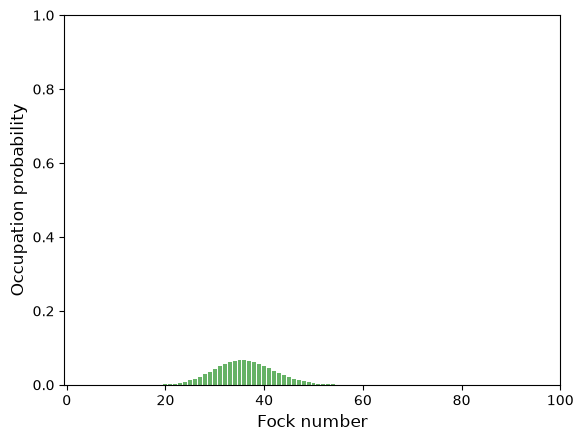
And some other density matrices, like a fock-state (or n eigenstate):
# With a Fock state (number state):
plot_fock_distribution(fock_dm(20,2))
(<Figure size 640x480 with 1 Axes>,
<Axes: xlabel='Fock number', ylabel='Occupation probability'>)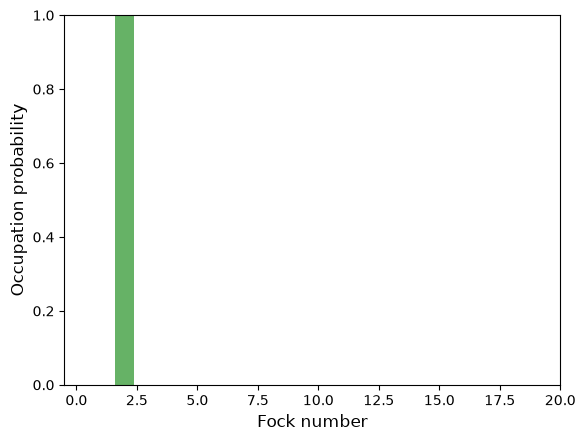
fock(20,2)Loading...
And a thermal state:
# A thermal state has decaying amplitudes
plot_fock_distribution(thermal_dm(20,2))
(<Figure size 640x480 with 1 Axes>,
<Axes: xlabel='Fock number', ylabel='Occupation probability'>)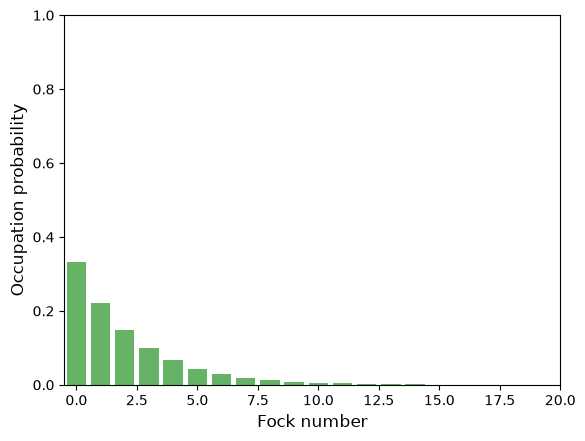
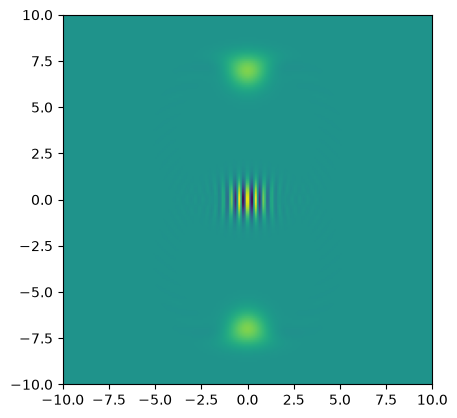
Finally, can visualize the phasor using what is called the Wigner function:
xvec = linspace(-10,10,200) # Create an array for the phase space coordinates.
plt.imshow(wigner(coherent(40,5j)+coherent(40,-5j),xvec,xvec), extent=[-10,10,-10,10]) # contour plot of Wigner function