Chapter 8 - Local Realism
with Alice and Bob
from numpy import sin,cos,pi,sqrt,angle,exp,deg2rad,arange,rad2deg
import matplotlib.pyplot as plt
from qutip import *
%matplotlib inline
H = Qobj([[1],[0]])
V = Qobj([[0],[1]])First define the projection operator for a state at angle :
def P(theta):
    """The projection operator for a state at angle theta"""
    theta_ket = cos(theta)*H + sin(theta)*V
    return theta_ket*theta_ket.dag()
Create the projection operators for each of the angles, two for Alice, two for Bob
Pa1 = P(deg2rad(19))
Pa2 = P(deg2rad(-35))
Pb1 = P(deg2rad(-19))
Pb2 = P(deg2rad(35))
Create the state :
psi=sqrt(0.2)*tensor(H,H) + sqrt(0.8)*tensor(V,V)Now, find the joint probability that Alice measures A1 and Bob measures B1. We do this by finding the expectation value of the projection operator for the joint state . This is formed as the tensor product of the two appropriate projection operators. In these tensor products, be sure to put Alice’s operator first, then Bob’s (just like we did for the signal and idler photons). Each operator acts on the photon corresponding to the order in the tensor() function.
Notice we’ll be using a new function expect(). This is equivalent to putting the operator in between the state bra and ket:
P1 = expect(tensor(Pa1,Pb1),psi)  # joint for A1, B1 (expect 0.09)
P2 = psi.dag()*tensor(Pa1,Pb1)*psi
P1 == P2TrueP10.09302920042790863Find the conditional probability
# B2 conditioned on A1 (expect 1)
Prob_b2_a1 = expect(tensor(Pa1,Pb2),psi)
#(psi.dag()*tensor(Pa1,Pb2)*psi).data[0,0]   # the joint probability
Prob_a1 = expect(tensor(Pa1,qeye(2)),psi)
#(psi.dag()*tensor(Pa1,qeye(2))*psi).data[0,0]  # the singular probability
Prob_b2a1 = Prob_b2_a1 / Prob_a1  # the conditional probability
Prob_b2a10.999939256912056Find the conditional probability
# A2 conditioned on B1 (expect 1)
# can do it all on one line:
expect(tensor(Pa2,Pb1),psi) / expect(tensor(qeye(2),Pb1),psi)0.999939256912056expect(tensor(Pa2,Pb2),psi) # joint for A2, B2 (classically expect 0.09, QM says 0)3.39573005293161e-05This is what we described in class.
What if the state was just ?
psi2=tensor(H,H)expect(tensor(Pa1,Pb1),psi2) # joint for A1, B1 (expect 0.09)0.7992456137533195# B2 conditioned on A1:
expect(tensor(Pa1,Pb2),psi2) / expect(tensor(Pa1,qeye(2)),psi2)0.6710100716628343# A2 conditioned on B1
expect(tensor(Pa2,Pb1),psi2) / expect(tensor(qeye(2),Pb1),psi2)0.6710100716628343# joint for A2, B2
expect(tensor(Pa2,Pb2),psi2)0.45025451627296204This is harder to interpret, but we clearly have different probabilities. Finally, check if we had used a mixed state:
A mixed state instead of the pure (entangled state).
Here we have to use the density matrix (since a ket cannot describe a mixed state). First some background:
QuTiP has a function that gives the density matrix from a ket state: ket2dm.
rho_mix = 0.2 * ket2dm(tensor(H,H)) + 0.8 * ket2dm(tensor(V,V))
rho_mix# joint for A1, B1
expect(tensor(Pa1,Pb1),rho_mix)0.1688370108679419# B2 conditioned on A1
expect(tensor(Pa1,Pb2),rho_mix) / expect(tensor(Pa1,qeye(2)),rho_mix)0.5609865818344059# A2 conditioned on B1
expect(tensor(Pa2,Pb1),rho_mix) / expect(tensor(Pb1,qeye(2)),rho_mix)0.5609865818344059# joint for A2, B2:
expect(tensor(Pa2,Pb2),rho_mix)0.1766384016124271We see that as we said in class for a state that obeys realism.
Now repeat with the pure state but using density matrix techniques.
This isn’t going to tell us anything new, but it shows how to work with the density matrix if you already know the ket state.
rho_pure = ket2dm(psi)  # convert from a ket to a density matrix (dm)
rho_pureThe calculations are actually the same in QuTiP, the expect function takes either a ket state or a density matrix.
# joint for A1, B1
expect(tensor(Pa1,Pb1),rho_pure)0.0930292004279086# B2 conditioned on A1
expect(tensor(Pa1,Pb2),rho_pure) / expect(tensor(Pa1,qeye(2)),rho_pure)0.999939256912056# A2 conditioned on B1
expect(tensor(Pa2,Pb1),rho_pure) / expect(tensor(Pb1,qeye(2)),rho_pure)0.999939256912056# joint for A2, B2:
expect(tensor(Pa2,Pb2),rho_pure)3.3957300529310896e-05These all agree (as they should).
Explore the angles in more detail:
Why these angles, 19 and 35?
psi=sqrt(0.2)*tensor(H,H) + sqrt(0.8)*tensor(V,V)angles = arange(1,90,1)rads = deg2rad(angles)Make a list of the probability of joint measurements for a pair of angles:
out = []
for r in rads:
    out.append(expect(tensor(P(-r),P(r)),psi))

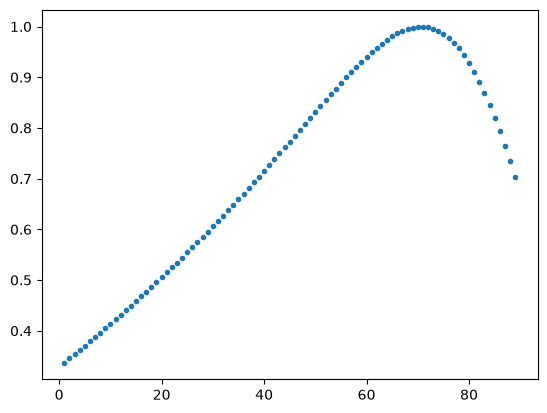
plt.plot(angles,out,".") # plot in units of pi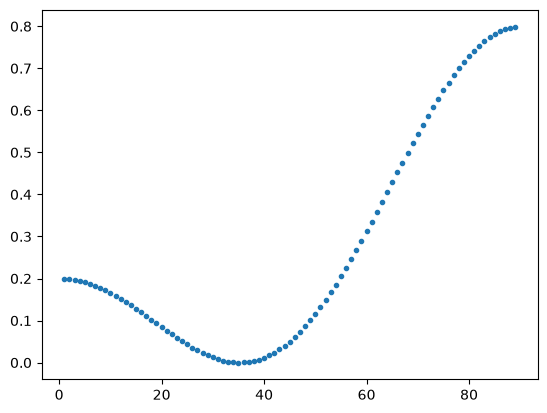
We see that the joint probabilities have a zero at 35 degrees. Now plug that in to one of the conditional probabilities and see what angle for the conditional probability gives 1:
out = []
for r in rads:
    out.append(expect(tensor(P(r),P(deg2rad(35))),psi) / expect(tensor(P(r),qeye(2)),psi))

plt.plot(angles,out,".")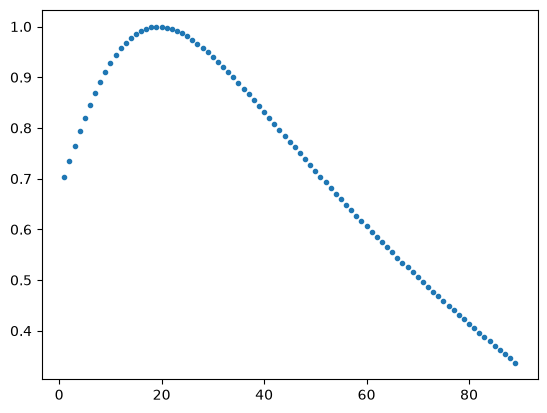
So only 19 and 35 work. Now, can you derive 19 and 35 given only the state ? Try the first plot, i.e. calculate the joint probability
Solution
Using the state, write the projection operators for a two photon state with angles and . First, recall
Next, form the two-photon state:
which we can reduce to:
Find the probability of a joint measurement of polarizations and :
Since only has and terms, this probability only has two terms:
Plot is shown below for and it agrees perfectly with our model above.
# Solution:
# For the first plot, we can show the joint probability for two angles is given by:

plt.plot(rad2deg(rads),(sqrt(0.2)*cos(-rads)*cos(rads) + sqrt(0.8)*sin(-rads)*sin(rads))**2)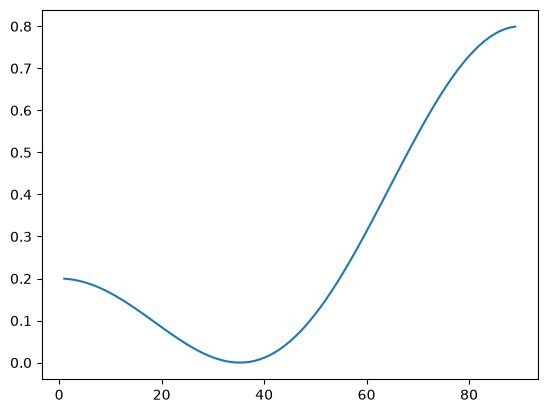
Challenge:
If we change the state to , the two angles that work for this state.
# Solution

psi3=sqrt(0.8)*tensor(H,H) + sqrt(0.2)*tensor(V,V)

out = []
for r in rads:
    out.append(expect(tensor(P(-r),P(r)),psi3))

plt.plot(angles,out,".") # plot in units of pi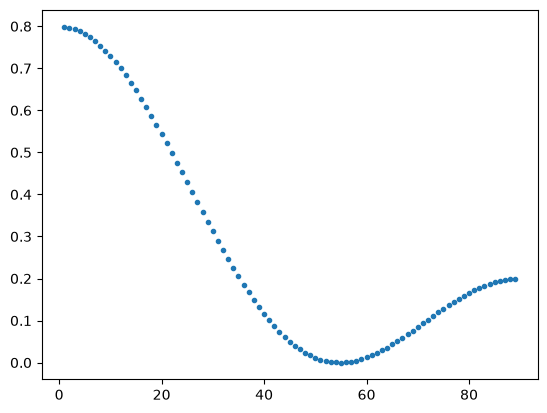
# Solution
out = []
for r in rads:
    out.append(expect(tensor(P(r),P(deg2rad(55))),psi3) / expect(tensor(P(r),qeye(2)),psi3))

plt.plot(angles,out,".")